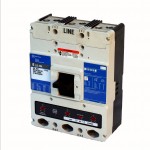
Many circuit breakers have labels displaying the breaker’s amperage rating and the interrupting current rating based on different voltage levels. Circuit breakers have an interrupting rating of so many thousands of amps at so many volts. The higher you go with voltage, the lower you should try to interrupt with the breaker. Another way, the available fault current should not exceed the interrupting rating of any of the circuit breakers on that circuit. Excluding some problem with an importer of inferior products that could not pass acceptance tests, it is doubtful that a circuit breaker manufacturer would produce a circuit breaker that could be used at 208 Volts and no higher. So circuit breaker manufacturers make a given breaker to handle multiple voltages. The first or highest interrupting rating applies when the system voltage is 240AC, 250 DC or 208 AC. The breaker could also have an interrupting rating for 480 Volts and an even lower interrupting rating for 600 Volts. You can not pick and choose the ratings to try to get more from a circuit breaker. Your system voltage dictates which interrupting rating applies.
A question asked by one of our customers:
You guys work on circuit breakers all the time. I have a used circuit breaker. I don’t know why it was laying around in the shop, but I checked it with a VOM and operated it. Checks okay and sounds okay. Is it okay, or is there more to it? My breaker is a 3 pole 100 amp plastic type circuit breaker.
Answer:
Yes, there is more to it. MIDWEST’s tests are (1) Voltage Related, (2) Current Related, and (3) Mechanical Related. The most serious deficiencies may be current, ie heat, related. MIDWEST overcurrent tests used and new circuit breakers. In addition to testing the overcurrent functions and insulation quality, we also test the condition of the contacts, including contact resistance. Poor breaker contacts can cause overheating and lead to serious damage.
By Jason Honick
The question often comes up. The answer: to a limited extent yes. Since molded case circuit breakers typically cost less than other types of breakers, cost effectiveness of rebuilding molded case breakers is a top concern. On one side of the spectrum older smaller molded case breakers would not be good candidates for a rebuilding procedure. However rebuilding procedures vary with the device at hand. For example, cleaning or replacing breaker current carrying contacts is a relatively cost effective procedure rendering it highly applicable to even some low cost breakers. Before going out the door our used breakers go through a series of checks per our Quality Control Program. As part of that program, breaker contacts would be tested for contact resistance. Based on those test results, the contacts would be cleaned or replaced if necessary. So in the overall view of things, the extent of molded case breaker reconditioning depends on the specific item at hand.