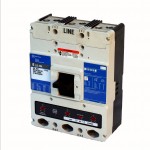
Buy 1200 Amp Square D Circuit Breakers
We had a conversation with a maintenance mechanic. He said he was a carpenter one day and an electrician the next, so he needed a little advice. He had some plastic circuit breakers that got washed down during clean up and, after they dried off, they looked great. But he wanted to know if he could still use them or if we could tell if they were okay. They were small single pole circuit breakers, a couple 200 amp circuit breakers, and one 1200 amp breaker. We call these molded case circuit breakers, but they are what everyone typically just calls circuit breakers. They also had some old obsolete bus plugs and some small transformers used for emergencies, that he just threw out. We told him to also throw out the little breakers and the 200 amp. Actually we told him to smash them so nobody would be tempted to reuse them. We have torn apart old and new circuit breakers after water damage and they are nasty inside. You do not want to reuse them. Very dangerous… Even if they worked mechanically, they could easily fail to interrupt load and turn into fireworks. We told him, if he wanted to, he could send us the 1200 amp breaker and we could take it apart and see if it could reliably be reconditioned. The chances of that are less than 50%. The real concern is whether or not the over current trip element in the circuit breaker got wet. If it did, it is very time consuming to take it apart and restore it to perfect working condition. And the quality control tests after the repair of a trip device are also time consuming. Many new circuit breakers have electronics which make reliable reconditioning after water damage almost impossible. One could do a simple clean up of a water damaged breaker and test it and it may pass all the simple routine tests. But internal inspection shows immediately that the circuit breaker, especially the circuit breaker trip device, is not reliable. We have seen water damaged used circuit breakers pass the basic insulation resistance, contact resistance, and over current tests, but fail our own additional special quality control tests. The internal inspection shows them to be in horrible condition. We find rust, free water, mud, and usually slime. If you have water damaged circuit breakers, just destroy them so no one thinks they are okay and tries to reuse them.

Buy Medium Voltage Air Circuit Breakers
We have always said, if you can’t do any maintenance on your circuit breakers, then at least exercise them whenever you have a chance. All circuit breakers, whether Square D, GE, Westinghouse, anyone’s, are much more reliable if they are exercised. High voltage or low voltage, they all need to be exercised. It’s the cheapest, easiest maintenance there is. It may not be real sophisticated, but it sure works. We saw this proven again during a plant maintenance shutdown. In this case the medium voltage vacuum circuit breakers had not been touched for 5 years, outdoors, cold winters, no heaters. Nearly all the lubricated mechanical operating parts were very stiff and many of the circuit breakers just would not operate. The good news is the breakers would have tripped open, but nobody in their plant was going to get many of them to close again. It was an old fashioned job of cleaning off the hardened lubricant and re-lubricating cautiously. Too much lubricant is a big problem in many facilities, especially one that does maintenance twice a decade. And one more note. Certain large old molded case circuit breakers, especially those used as main breakers, are extremely vulnerable to stiffing up if they are not operated a few times.
Circuit breakers are unlike fuses as they are designed to open and close all three phases at once. This is a definite plus as the power can be restored after the system problem has been corrected. But even circuit breakers have their warts. They can be slower acting than fuses and sometimes one or more of the poles can fail in the ‘open’ or ‘closed’ position. If they have not been maintained for years, they could act even slower than usual or worse they may not react to a faulted condition at all. This could result in the same kind of overheating condition you could experience with two out of three fuses providing some power to a machine. You know where one fuse blows or ‘goes’ prematurely and the other two hold and then you slowly cook the machine’s motor to death. Why? Because the power from the remaining two phases, if it will spin the motor at all, will not be able to turn the fan blade on the motor shaft fast enough to provide adequate cooling.
Best remedy to keep circuit breakers fit is to routinely open and close them to keep the mechanisms moving a few times, maybe ten or so times, so all of the moving parts break through any accumulated buildup of grease and grime. Remember just because a machine is not moving does not mean the power is turned off.
Many circuit breakers have labels displaying the breaker’s amperage rating and the interrupting current rating based on different voltage levels. Circuit breakers have an interrupting rating of so many thousands of amps at so many volts. The higher you go with voltage, the lower you should try to interrupt with the breaker. Another way, the available fault current should not exceed the interrupting rating of any of the circuit breakers on that circuit. Excluding some problem with an importer of inferior products that could not pass acceptance tests, it is doubtful that a circuit breaker manufacturer would produce a circuit breaker that could be used at 208 Volts and no higher. So circuit breaker manufacturers make a given breaker to handle multiple voltages. The first or highest interrupting rating applies when the system voltage is 240AC, 250 DC or 208 AC. The breaker could also have an interrupting rating for 480 Volts and an even lower interrupting rating for 600 Volts. You can not pick and choose the ratings to try to get more from a circuit breaker. Your system voltage dictates which interrupting rating applies.
By Jason Honick
The question often comes up. The answer: to a limited extent yes. Since molded case circuit breakers typically cost less than other types of breakers, cost effectiveness of rebuilding molded case breakers is a top concern. On one side of the spectrum older smaller molded case breakers would not be good candidates for a rebuilding procedure. However rebuilding procedures vary with the device at hand. For example, cleaning or replacing breaker current carrying contacts is a relatively cost effective procedure rendering it highly applicable to even some low cost breakers. Before going out the door our used breakers go through a series of checks per our Quality Control Program. As part of that program, breaker contacts would be tested for contact resistance. Based on those test results, the contacts would be cleaned or replaced if necessary. So in the overall view of things, the extent of molded case breaker reconditioning depends on the specific item at hand.