Archive

Archive for the ‘Uncategorized’ Category

Removing Cover from an Energized Breaker

November 19th, 2010 Comments off


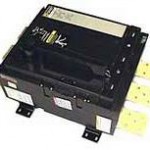
MIDWEST had a customer call and ask if it was okay to remove the cover from an old 400 amp circuit breaker, live. Our Infrared Scan indicated the load side connection was overheating. They wanted to repair it, but didn’t want to turn the power off to the whole panel board. They needed to remove the cover of the circuit breaker to make the repair and thought they could just remove the four screws holding the cover on and carefully remove the cover. We explained politely that they were crazy to try such a thing. This was an old molded case circuit breaker and the arc chutes for this breaker were not fastened in place as they are in some breakers. In addition, the arc dividers were metal and they were held together with an insulated band. On some of these breakers we have to tape the band to hold the arc dividers together or they just fall apart. So the danger would be that you remove the cover with the line side still hot and one of the arc chutes falls out and the metal arc dividers fall apart. It would be almost certain that one of the metal arc dividers would short a stationary contact to a moveable contact and cause a horrific arcing blast, arcing fault.  Depending on the instantaneous, ie fault, setting of the main breaker, the fault might last for seconds and result in tremendous damage to the equipment and expose anyone nearby to serious injury or death from an arc blast. Because the fault is on the line side of the breaker, it wouldn’t take much to create a panel board bus fault. This is a good way to get someone seriously injured or killed and a good way to destroy a whole panel board. To remove the cover off any circuit breaker with the line side hot is a very bad idea. But to remove the cover of some of the older circuit breakers, with the line side hot, is just crazy because of the construction of the breaker. Inside molded case circuit breakers there are other devices that may fall out when you remove the cover. Besides all this, there may be something defective inside the breaker, just waiting there, for the first unfortunate person to take the cover off, and then it falls apart or breaks completely. You could get very unlucky. We call these things incipient failures and they can be some of the most nasty and dangerous defects in electrical equipment, because you are not expecting them. This is true whether it’s a Square D, Cutler Hammer, Westinghouse, GE General Electric, or Siemens circuit breaker or any other breaker manufacturer. Turn the main power off!

Circuit Breaker Infrared Scanning Disagreement – Lugs

October 27th, 2010 Comments off

Infrared Scan of a Circuit BreakerWe read about a disagreement between two bloggers over whether or not infrared scanning, or thermography, was needed if you torque tightened the wire connections to power circuit breaker terminals during routine maintenance.  What occurred to MIDWEST were all the possible deficiencies we find in old, new, and replacement circuit breakers, using infrared scanning, that have nothing to do with whether or not the load terminals were tight.  One of the nasty deficiencies is when the cable lug in an old circuit breaker is very tight, but the lug is overheating because the screw, holding the lug to the breaker output tab, is loose. We’ve seen brand new circuit breakers and replacement circuit breakers fry the load side tab of the breaker so bad that the breaker had to be replaced. This is true for new or old Square D, GE General Electric, Westinghouse, Siemens, Cutler Hammer, ABB, any manufacturer. It has nothing to do with a specific circuit breaker manufacturer.


Sometimes the lug is welded to the tab from the arcing between the lug and tab. There is a very sophisticated test one can perform during a maintenance outage to check for this defect. First, check for voltage at the load and line side of the de-energized circuit breakers. Don’t care that the main breaker is off and all the feeder breakers are open.  Check voltage anyway.  You are checking for something that shouldn’t be, not for something you know should be.  We, rather I, have personal experience with getting my hand blasted because a breaker was back fed. Very bizarre set up, unbelievable, just waiting to injure someone.


After checking for voltage, carefully and gently try to move the conductor coming out of each phase of each circuit breaker.  You are trying to see if the cable is loose in the lug and you are trying to see if the lug is loose, moves or turns, in the circuit breaker. You are not trying to force it to move. Just use enough force to see if it is loose in the circuit breaker. If the lug itself is loose, the cable or cables will need to be removed from the lug; The mounting screw for the lug properly tightened; The cables properly reinstalled; And the cables tightened in the lug. Again, don’t be too forceful. On small breakers, you can always make the lug move. Repeating, you just want to use enough force to see if the lugs for that old obsolete circuit breaker are loose.


If the conductive interface, between the lug and the circuit breaker, is damaged from severe overheating or arcing, the defective circuit breaker may need to be replaced. Sometimes the damaged area can be repaired.  MIDWEST does not recommend replacing power circuit breakers while the switchboard is energized. Be safe. Turn things off. Check for voltage everywhere.

Old or New Circuit Breaker Hearing Test

October 13th, 2010 Comments off


PAL36200 Square D Molded Case Circuit Breaker

PAL36200 Square D Molded Case Circuit Breaker

How would you feel if you were an Engineering Technician and you had just spent over an hour maintaining and testing a Square D PAL362000 circuit breaker and the Engineer walked up, operated the PAL362000 one time and said “It’s junk, throw it out?”  You might think the Engineer should be thrown out. But actually, the Engineer was just confirming what the technician already knew. In this case the circuit breaker had been inspected for any deficiency. The cover had been removed, yes, carefully, and the contacts, arc chutes, operating mechanism were all checked and maintained. The line and load side terminals of the old Square D PAL362000 were clean and in good condition. There was no sign of rust, worn main contacts or arc damaged arcing contacts. The operating mechanism visually looked in good condition. There was discoloration to the movable contact fingers of each pole piece. 


Tests were performed on the PAL362000 over current devices.  The test results were all good.


The contact resistance test results and the insulation resistance test results were all good.  The reset tests were all good.  So what was wrong with this expensive PAL362000 Square D circuit breaker?  There were two things wrong with the breaker. One deficiency was suspected based on the inspection and test procedure. The other was determined based upon our experience servicing Square D PAL362000 and PAF362000 circuit breakersFirst of all the movable contact fingers, ie pole pieces, were discolored.  We have seen this before and it usually means the circuit was heavily loaded.  In this case the circuit breaker was on a feeder that routinely hit 1800 amps and occasionally the breaker had tripped due to the load.  The other thing that told us the breaker was defective was also based on experience.  The experience of operating Square D PAL361000, PAL361200, PAL361600, PAL362000, PAF361000, PAF361200, PAF361600 and PAF362000 circuit breakers has taught us to listen carefully to the closing and opening of the three pole pieces, the moveable contact assemblies. Circuit Breakers that have been in very harsh conditions or operated under continuous heavy load, have a tendency to not open and close all three pole pieces simultaneously. When the breaker is defective, you can hear two or more poles close or open at different times. You will hear two separate distinct contact closings or openings. We know, if the difference is very obvious, repair attempts tend to be very temporary. With proper cleaning, lubrication, and exercising, the breaker may seem to operate properly. But we know from experience, the following year, or even in a few months, the breaker will again not close or open properly.  In these days of real concern for arc flash hazard protection, this defect can not be ignored.


In the example discussed here, the Engineer just confirmed what the technician already knew. The Square D circuit breaker failed the hearing test. In this case experience rules. And it applies to Westinghouse, Cutler Hammer, GE General Electric circuit breakers also.

Fire Hazards of Surge Suppressor Strips with Integral Circuit Breakers

September 27th, 2010 2 comments

MIDWEST’S Engineering Department has had several customer’s ask to investigate some fires that have occurred in their offices.  These fires were caused by commercial surge suppressor strips.  Each strip had integral circuit breakers.  In each case, neither the integral circuit breakers nor the distribution panel’s circuit breakers tripped.  


National Fire Protection Association (NFPA) has researched and documented innumerable cases where the surge suppressors have caught fire.  In many cases, large fires have resulted; thus the NFPA’s concern.  The surge suppressor strips typically contain a circuit breaker and three or more metal oxide varistors.  Metal oxide varistors are non-linear circuit components that conduct large currents when the applied voltage exceeds a certain value, usually 130 Volts AC RMS.  


In the intended application, the varistors conduct in the presence of large voltage transients, such as from a lightening strike.  But a large transient of Kilovolts is not the only situation that can cause the varistor to conduct.  A small overvoltage can also cause conduction.  Of course, small is relative.  In this context, small might be a voltage increase such that the applied voltage is double or triple the normal 120 Volts, and can exist for hours.  Such events can result from wiring failures in the power distribution system.  In this case, the varistors will conduct small currents, perhaps just a few amperes.  However, the double or triple voltage will still be dropped across the varistor.   So, since power P = E * I, it is obvious that hundreds of watts will be dissipated as long as the overvoltage exists.  Since varistors are typically only rated for about 1 watt continuous, severe overheating will occur.  Such severe heat generation will result in destruction of the varistor and cooking of circuit boards.  These elements are often reduced to just carbon, which continues to conduct, and continues the generation of heat inside the surge suppressor.  The result can be a fire.  Undiscovered, the building can burn down.


It is salient to note that if just a few amperes flow, then neither the internal circuit breaker nor external circuit breakers will trip, as these are probably rated at 15 or 20 amps.


Underwriter’s Laboratories has tried to address this issue in the following revisions of UL 1449:

  • 2nd revision of UL 1449, titled ““UL Standard for Safety for Transient Voltage Surge Suppressors”.  Compliance with this revision is mandated as of February 2007.
  • 3rd revision of UL 1449, titled “UL Standard for Safety for Surge Protective Devices”.  Compliance with this revision is mandated as of September 2009.   This revision has also become an ANSII standard.

Surge Suppressors, Circuit Breakers, and Red Herrings

September 20th, 2010 Comments off

A large municipality had a very frightening situation recently.  It seems that a dozen surge suppressor strips (with internal circuit breakers) underneath office workers’ desks had overheated to the point of starting small fires internal to the strips.


MIDWEST was contracted to solve the problem.  MIDWEST’s Engineering Department installed Dranetz line monitoring equipment (Dranetz is the gold standard of line monitors). 


The results revealed a very, very interesting situation.  The line monitoring equipment discovered two anomalies. 


First, the 120 volt line was continuously about 8% too high;utilities guarantee a high line tolerance of 5%.  Thus the customer’s line voltage was 3% higher than the utility allows.


Secondly, some large short term voltages were measured on the customer’s neutral to ground by the Dranetz.   


In addition, forensic analysis was performed on the surge suppressors.  It was found that in all instances, the internal voltage spike protecting component, the metal oxide varistors (MOV) had burned themselves up, due to long term overheating.  In doing so, much of the underlying printed circuit board was also burned up and carbonized.  This carbonized material continued to support a small current and generate heating in the strips.  However, the internal circuit breakers never tripped.  The fact that the circuit breakers never opened is a very critical clue.


At first glance, the “obvious” conclusion one could draw is that the 8% high line condition caused the varistors to conduct, causing the overheating.   


But, the obvious conclusion would be wrong.  The 8% high line condition is just a red herring in this investigation.  Referring to the V-I characteristic curves of the varistors, an 8% overvoltage would cause negligible current flow.  In order for the 1 watt rating of the varistor to be exceeded, double or triple the nominal voltage would have to be applied for at least several minutes; the varistors would conduct around an ampere or less.   This is far less than the 15 ampere rated current of the circuit breaker.   


The surge suppressor strips’ melted plastic housings, and the extensive baking of the printed circuit boards to carbonization indicated heating on the order of minutes.  


On the other hand, a typical large voltage spike of several thousand volts tens lasting tens of microseconds tend to explode varistors, creating a plasma ball, and spraying superheated varistor material and copper everywhere around the sacrificial varistor.   The plasma ball would act like a dead short circuit, causing an internal arc flash of hundreds of amperes.  This would have tripped the circuit breakers.  A typical varistor explosion usually sounds like a gunshot; however, no such noises were heard by personnel.  The author has personally witnessed these explosions during destructive testing of varistors under controlled conditions.  The surge suppressor post-mortems’ also revealed no deposited spray of bulk varistor material or of copper.


The only conclusion that could be drawn is that double or triple the nominal line voltage actually was existent for several minutes, rather than a one-time voltage spike.  This conclusion is supported by the anomalous Dranetz neutral to ground measurements.

Poor Connections Nearly Start Fires

September 14th, 2010 Comments off

A recent customer called MIDWEST, saying that they had a dozen surge suppressor strips that almost caught on fire.  The strips had been powering computers for a large municipality.  Much to the consternation of the secretaries, the strips started smoking ominously right next to their feet under their desks.  These were high quality surge suppressors, each of which contained  circuit breakers, and three metal oxide varistors.     Very strangely, neither the circuit breakers inside the surge suppressors nor the panelboards’ circuit breakers tripped.  The computers that were plugged into the surge suppressors just continued to crank away, despite the smoke and incipient fires.


MIDWEST engineers dissected the burned surge suppressor strips, and found that the metal oxide varistors had catastrophically overheated due to a long term overvoltage condition, rather than a one-time voltage spike. This long term overheating baked the printed circuit boards. The boards had carbonized, thus supporting extraneous current flow and copious quantities of heat and smoke.  The current was below the trip level of all the circuit breakers, so they had not opened and not interrupted the current flow.


MIDWEST’s Engineering Department installed line voltage monitoring equipment at the main distribution panel’s circuit breakers.  After a couple of weeks, sufficient data was collected that indicated the probable cause was failures in the grounding and neutral connections relating to the 300 KVA distribution transformer.    


MIDWEST’s Engineering Department’s decades of experience and proven expertise in power electronics was essential in diagnosing the problem.   

3 Second Sophisticated Circuit Breaker Test

August 23rd, 2010 Comments off

Here is another MIDWEST real world experience. This time dealing with circuit breakers, specifically three old power air circuit breakers.  Because of the extremely difficult location of the breakers, getting equipment to test the old circuit breakers was nearly impossible. And the cost would have been astronomical. There seemed to be serious problems with the circuit breakers. These were bolted in place generator breakers and the switchboard they were in had to provide power at all times.  A short outage could be catastrophic. But the breakers were tripping and the generator operators needed to know if the breakers were the problem or if they had load problems somewhere in their power system. The circuit breakers had old oil dashpot type over current devices and the operators wanted to know if retrofitting the circuit breakers with new electronic over current devices would make their problem go away. So, during a rather tense meeting, MIDWEST recommended the following three tests on two poles of each breaker.  The first test would take about 3 seconds. The second test would take about 8 seconds. And the third test could take as long as 90 seconds. We thought these tests would be nearly 100% as effective as actual high current testing in determining the condition of the dashpot over current devices. These were not calibration tests. They were function tests. The first sophisticated test procedure was to look at the oil dashpots. If we saw signs of oil weepage out of the circuit breaker oil filled dashpots, the breaker over current protective devices, ie the oil dashpots, were deficient and the breaker should be retrofitted. Simple. The second test involved manually pushing the instantaneous lever of the old oil dashpots.  If the action and resistance was normal and the dashpot reset properly, no nuisance problem.  The third and last test was to simulate an over current condition by a slow steady push on the delay component of the dashpots on the outside phases. For a veteran in the maintenance, repair and testing of these old air circuit breakers, these checks are very simple and very reliable in detecting defective oil dashpots. The actual test time per circuit breaker took us less than 45 seconds. We were not calibrating anything, but we did determine that all three circuit breakers had defective over current protective devices and needed to be retrofitted with new electronic over current protection. This was done and their problem was solved. How the retrofitting was done is a good subject for another blog. By the way, these circuit breakers were located in Antarctica.